


What is nitrogen and where is it used? Inerting, laser cutting and food
Nitrogen properties, how it is produced, applications from inerting to laser cutting, purity selection and the risks of liquid nitrogen.
2 min read
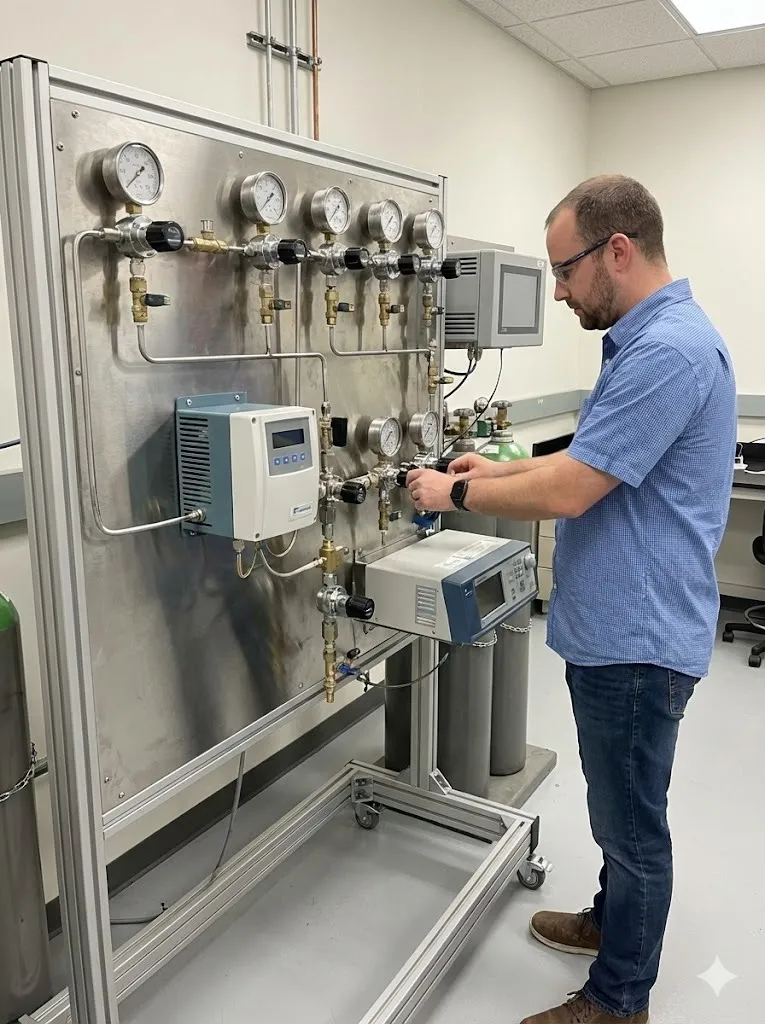
Nitrogen makes up about 78% of air and is the most consumed gas in industry. Almost every application follows from a single property: taking the place of oxygen where oxygen is unwanted. Reducing fire risk, protecting a product from oxidation, purging a line — all are versions of the same idea.
Basic properties
| Property | Value |
|---|---|
| Symbol | N₂ |
| Share of the atmosphere | ~78% |
| Appearance and odour | Colourless, odourless, tasteless |
| Flammability | Neither burns nor supports combustion |
| Chemical behaviour | Unreactive at normal temperatures |
| Density vs air | Almost the same as air |
Unlike argon, nitrogen has almost the same density as air; it does not pool at floor level as noticeably, but the risk of diluting oxygen in a confined space applies just as much.
How it is produced
Industrial nitrogen is mostly obtained by cryogenic separation of air, which delivers high purity and large volumes. Where lower purity is sufficient it can also be generated on site with membrane or PSA (pressure swing adsorption) systems. Which route suits you depends on your consumption and the purity you need.
Applications
- Inerting and purging. Prevents flammable vapour–air mixtures forming in tanks, reactors and pipelines. A basic safety practice in chemicals and coatings.
- Laser cutting. Stainless and aluminium cut with high-pressure nitrogen have an oxide-free edge, needing no extra cleaning before painting or welding.
- Food. As filler and oxygen-displacing gas in modified atmosphere packaging; details in our MAP article.
- Welding and heat treatment. In root shielding mixtures for stainless pipe welding, and as a protective atmosphere in heat treatment furnaces.
- Electronics and pharmaceuticals. As the ambient gas in production steps that must be protected from moisture and oxygen.
- Liquid nitrogen. In low-temperature applications such as rapid freezing, shrink fitting and sample storage.
Which purity?
Purity requirements vary widely by application. Our guide holds the data sheets for the different grades: Pure Nitrogen, 60 Grade Nitrogen and High Purity Nitrogen 99.999%.
Safety
- It is an asphyxiant. Not toxic; the risk is oxygen dilution. Measure oxygen before working in a confined space.
- It is odourless and colourless. A leak cannot be sensed; the only warning comes from an instrument.
- Liquid nitrogen is extremely cold. Direct contact causes serious cold burns; suitable gloves and face protection are essential.
- Liquid-to-gas expansion is very large (in the order of 1 to 680). Evaporation in a closed volume creates dangerous pressure and rapid oxygen loss; ventilation is critical.
Supply
Nitrogen is supplied in cylinders, manifold bundles and as bulk liquid. Share your monthly consumption, required purity and point of use and we will determine the most suitable format together. Review our industrial gases family.
More technical articles
-
Choosing a shielding gas for MAG welding: what the CO₂ ratio changes
The CO₂ ratio in an argon–carbon dioxide mixture directly changes penetration, spatter and bead appearance. Here is how DIN EN ISO 14175 classes work and which mixture suits which job.
-
Modified atmosphere packaging (MAP): how gas extends shelf life
What nitrogen, carbon dioxide and oxygen do inside the pack, typical atmospheres by product group, and what “food grade gas” actually means.
-
Gas cylinder colour codes and safe handling: an EN 1089-3 guide
What the shoulder colour tells you, which gas carries which colour, and the rules that apply in storage. EN 1089-3 colour coding plus practical safety notes.