


Calibration gases and specialty mixtures: your reading is only as good as your gas
What certification, traceability and uncertainty mean for a calibration gas, how to choose the balance gas, and what to watch for with reactive components.
2 min read
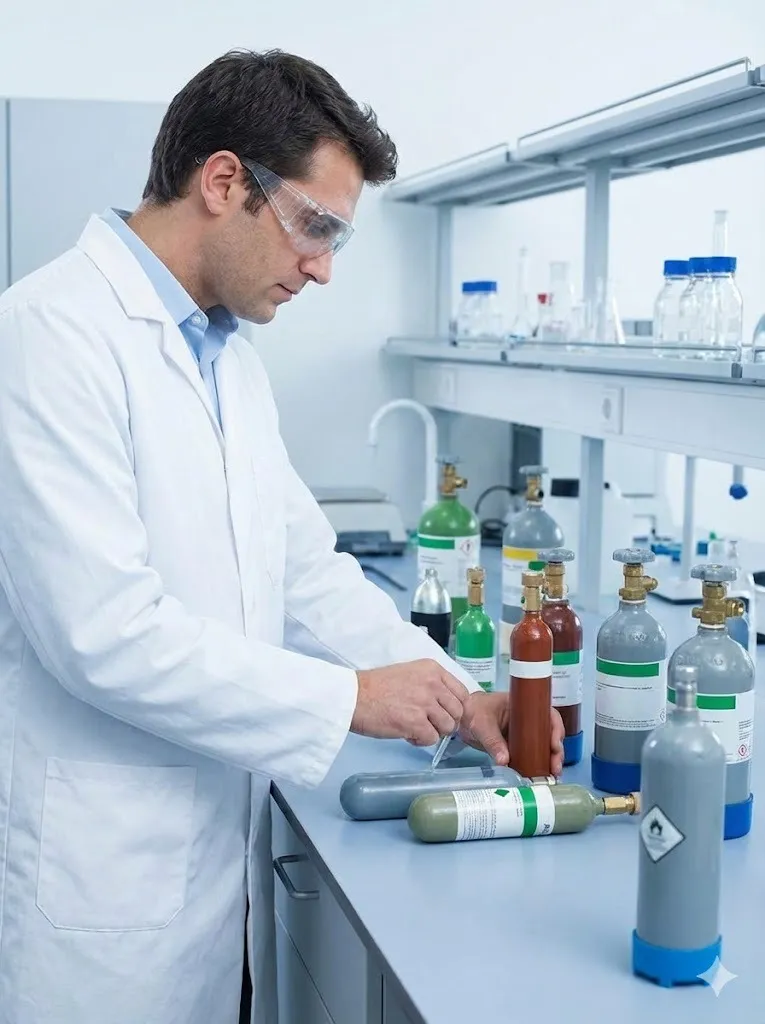
A gas analyser or detector is only as accurate as the reference it is shown. However good the instrument, if the composition of the calibration gas is uncertain then so is the reading. A calibration gas is therefore not a consumable but part of the measurement chain.
What is a calibration gas?
A calibration gas is a mixture containing one or more components at a known, documented concentration. Work is usually done with two points:
- Zero gas: a gas free of the measured component, which sets the instrument’s zero point. Usually high purity nitrogen or synthetic air.
- Span gas: a mixture at a known concentration near the top of the working range, which sets the instrument’s slope.
What to look for on the certificate
| Information | Why it matters |
|---|---|
| Certified concentration | The analysed value governs, not the nominal figure on the label |
| Uncertainty | The uncertainty of your own result starts here and belongs in your budget |
| Traceability | Shows the value is linked to an accepted reference; requested in audits |
| Balance gas | Nitrogen, synthetic air or argon — it can affect instrument response |
| Expiry date | Mixtures can drift over time; calibration with expired gas is invalid |
| Minimum residual pressure | Below this value the composition loses reliability |
Choosing the balance gas
The balance gas makes up most of the mixture by volume and is not an innocent choice. Flammable gas detectors, for example, may depend on the oxygen in air; a nitrogen-balanced mixture may not produce the expected response. Use whatever balance gas the instrument manufacturer specifies.
Reactive components and passivation
Components such as hydrogen sulphide, ammonia and sulphur dioxide adsorb onto the cylinder’s inner surface, and in an ordinary cylinder the concentration falls over time. These mixtures are prepared in cylinders with specially treated (passivated) interiors. The same care applies to the regulator: reactive gases call for a stainless-bodied regulator with low dead volume.
Common mistakes
- Using the cylinder to the last. Below the minimum pressure the composition changes, producing measurement error that goes unnoticed.
- Long or unsuitable tubing. Flexible plastic hose both adsorbs and lets gas through from outside; use short tubing of a suitable material.
- Not purging the regulator. Air trapped in the connection distorts the first readings.
- Using one regulator for different gases. Cross-contamination distorts readings, especially at low concentrations.
- Not keeping the certificate. It is the first document requested in an audit.
Specialty mixtures
Beyond calibration, mixtures blended for a specific application belong to this family too. Our guide holds examples: P10 (90% argon + 10% methane) as the counting gas for proportional counters in radiation measurement, and 4126 Specialty Gas Mixture, blended according to the application.
Start by reviewing our specialty gases family, or look through the data sheets in the gas guide for high purity requirements.
More technical articles
-
Choosing a shielding gas for MAG welding: what the CO₂ ratio changes
The CO₂ ratio in an argon–carbon dioxide mixture directly changes penetration, spatter and bead appearance. Here is how DIN EN ISO 14175 classes work and which mixture suits which job.
-
Modified atmosphere packaging (MAP): how gas extends shelf life
What nitrogen, carbon dioxide and oxygen do inside the pack, typical atmospheres by product group, and what “food grade gas” actually means.
-
Gas cylinder colour codes and safe handling: an EN 1089-3 guide
What the shoulder colour tells you, which gas carries which colour, and the rules that apply in storage. EN 1089-3 colour coding plus practical safety notes.