


Choosing regulators and gas equipment: single stage or two stage?
Pressure, flow, material and connection in regulator selection; why a flashback arrestor is mandatory and what gets missed in hose maintenance.
3 min read
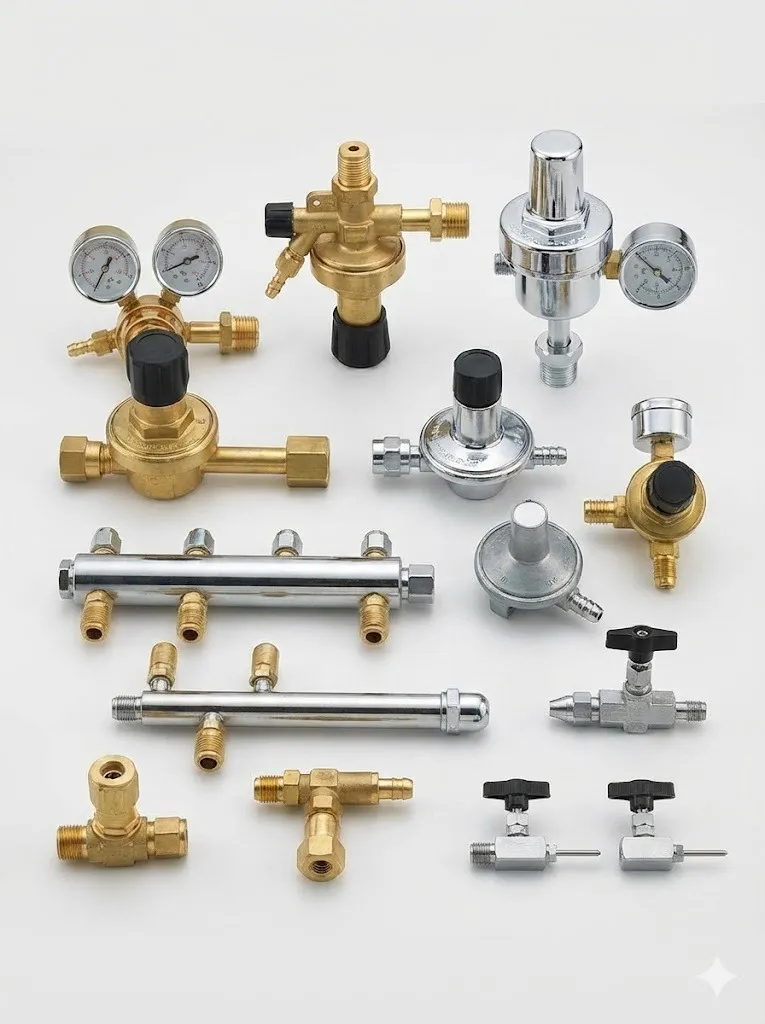
The cylinder may be correctly chosen, but if the hardware between cylinder and application is wrong the outcome is still poor: fluctuating pressure, bad welds, inconsistent readings, or an outright safety risk. This article collects regulator and ancillary equipment selection into practical criteria.
What a regulator does
A regulator reduces the high pressure in the cylinder to the working pressure the application needs and tries to hold that pressure steady as the cylinder empties. Of the two gauges, one shows cylinder pressure (gas remaining) and the other outlet pressure.
Single stage or two stage?
| Single stage | Two stage | |
|---|---|---|
| Operation | Reduces pressure in one step | Reduces it in two steps |
| As the cylinder empties | Outlet pressure drifts somewhat | Outlet pressure is markedly more stable |
| Suited to | Short jobs where the setting can be corrected by hand | Long runs, analytical instruments, precision welding |
| Cost | Lower | Higher |
A practical rule: if an operator is already watching the setting continuously, single stage is enough. If you are feeding an instrument or need constant pressure across a shift, choose two stage.
Material and connection
- A brass body is the standard solution for inert and non-corrosive gases.
- A stainless body is for corrosive components and high purity applications; the inner surface is finished to reduce adsorption.
- Connection outlets differ by gas, and this is a deliberate safety design: it stops a flammable gas being fitted to oxygen equipment.
- A flowmeter type makes it easier to set l/min directly when welding.
Flashback arrestor: not negotiable
A flashback arrestor prevents the flame travelling back from the hose towards the cylinder. On oxy-fuel sets — particularly when working with acetylene — it is a critical safety device and is expected at both the regulator and the torch end. After a flashback, equipment should not be used again until it has been checked.
Hoses and torches
- Hoses are colour-coded by gas; oxygen and fuel gas hoses are never interchanged.
- Check regularly for cracking, hardening and crushing; a worn hose is the most common cause of leaks.
- Use proper clamps; wrapping wire is not a connection method.
- Torches and tips are chosen to suit the job; a blocked tip distorts the flame geometry.
The oxygen line: a world of its own
Daily habits
- Loosen the adjusting screw before fitting the regulator; open the cylinder valve slowly.
- Do not stand in line with the outlet while opening the cylinder valve.
- Check for leaks with a foaming solution — never with a flame.
- When the job is done, close the cylinder valve, purge the line and loosen the adjusting screw.
- Take a regulator out of service if the gauge glass is broken or the needle does not return to zero.
Let us choose the right hardware together
Share the gas you use, your working pressure, your flow and your application, and we will determine the right regulator, flashback arrestor and hose set together. Start by reviewing our gas equipment family, and see our colour codes article for cylinder safety.
More technical articles
-
Choosing a shielding gas for MAG welding: what the CO₂ ratio changes
The CO₂ ratio in an argon–carbon dioxide mixture directly changes penetration, spatter and bead appearance. Here is how DIN EN ISO 14175 classes work and which mixture suits which job.
-
Modified atmosphere packaging (MAP): how gas extends shelf life
What nitrogen, carbon dioxide and oxygen do inside the pack, typical atmospheres by product group, and what “food grade gas” actually means.
-
Gas cylinder colour codes and safe handling: an EN 1089-3 guide
What the shoulder colour tells you, which gas carries which colour, and the rules that apply in storage. EN 1089-3 colour coding plus practical safety notes.